
Nuisance Ants (Various Species)
Quick Facts
Quick Facts
Common species in Wisconsin: Pavement ant (Tetramorium immigrans), Odorous house ant (Tapinoma sessile), and others
Size: Generally small (about 1/16 to 1/8 inch)
Color: Dark brown to black
Main issue: Indoor foraging and food contamination
Do not cause structural damage (unlike carpenter ants)
Identification
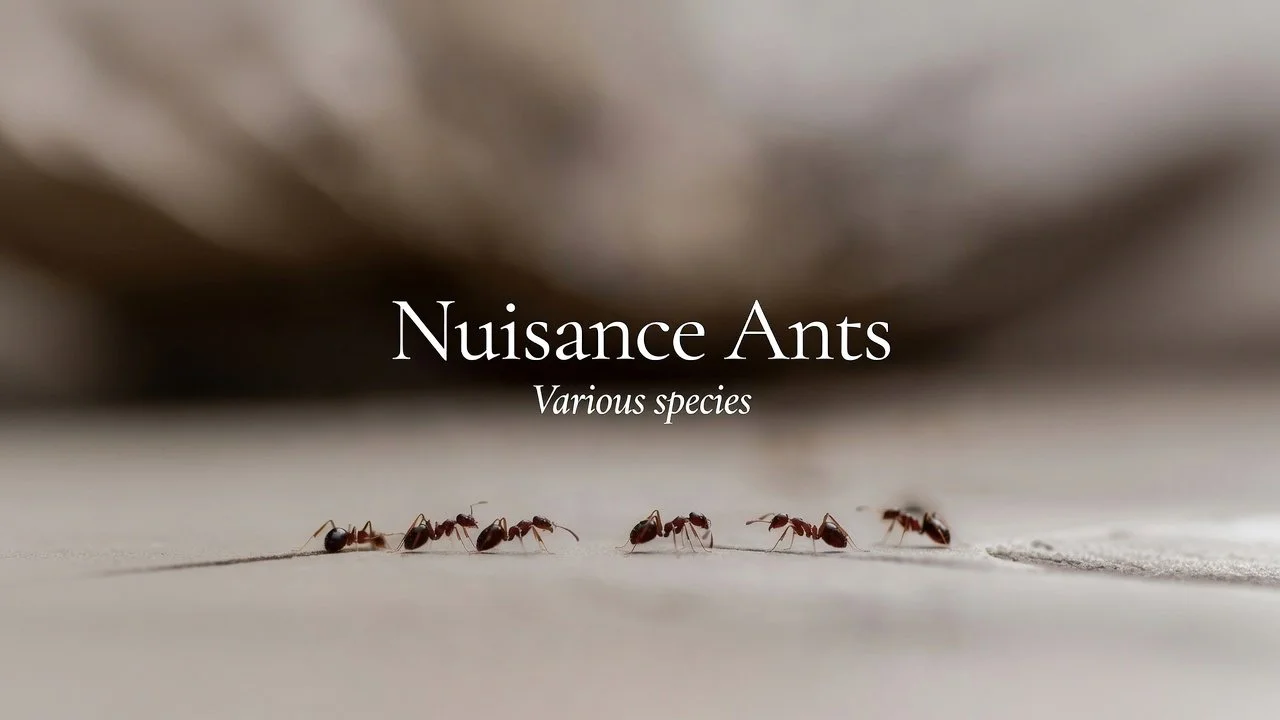
Nuisance ants are the small dark ants most often found trailing across kitchen counters, floors, and baseboards.
Pavement ants: Dark brown to black, about 1/8 inch, two nodes on the waist, fine grooves on the head and thorax. Often nest under sidewalks, driveways, and foundation slabs.
Odorous house ants: Dark brown to black, about 1/10 inch, one hidden node, uneven thorax profile. Emit a rotten coconut or blue-cheese smell when crushed.
Both are much smaller than carpenter ants and lack the large size and rounded thorax of Camponotus.
Biology & Life Cycle
These ants form colonies with one or more queens. Pavement ants typically have moderate-sized colonies under concrete or soil. Odorous house ants can form large multi-queen “supercolonies” that spread through wall voids and outdoor nesting sites.
Workers forage for a wide range of foods — sweets, proteins, grease, and pet food — and leave scent trails that bring more ants to the source.
Habits & Behavior
Nuisance ants enter homes seeking food and water. They commonly trail along edges, under appliances, and near plumbing. Activity increases in spring and summer, and they may move indoors during heavy rain or extreme heat/cold.
They do not excavate wood or cause structural damage.
Signs of Infestation
Trails of small dark ants on counters, floors, or baseboards
Ants around sinks, pet food bowls, or trash
Outdoor nests under slabs, sidewalks, or landscaping
(Odorous house ants) Distinctive smell when crushed
Health & Property Risks
These ants do not bite or sting in any significant way and do not transmit disease. The primary concerns are:
Contamination of food
Persistent indoor presence
Difficulty eliminating multi-queen colonies without proper treatment
Prevention Tips
Store food in sealed containers
Clean up crumbs, spills, and grease promptly
Rinse recyclables and empty trash regularly
Keep pet food bowls clean and pick them up overnight
Seal cracks and gaps around foundations, windows, doors, and utility penetrations
Reduce moisture sources (fix leaks, improve drainage)
Keep mulch and landscaping pulled back from the foundation
Treatment Approach
Baits are usually the most effective method because workers carry the bait back to the colony. Liquid residual treatments around the exterior and entry points support the baiting program.
Avoid spraying over bait stations — this can repel ants and reduce bait acceptance. For persistent or multi-queen colonies (especially odorous house ants), professional treatment is often needed to reach the full colony.
When to Call a Professional
Call if:
Ant trails keep returning after DIY efforts
You see large numbers indoors regularly
Multiple rooms or areas are affected
You cannot locate the outdoor or indoor nesting sites
Local Notes
Pavement ants and odorous house ants are the most common household ant complaints across Racine County and southeastern Wisconsin. Pavement ants frequently nest under slabs and sidewalks, while odorous house ants are notorious for spreading through wall voids and forming large colonies. Both are active from spring through fall and can become indoor problems during weather extremes.