
Carpenter Bee (Xylocopa spp.)
Quick Facts
Scientific name: Polistes spp.
Adult size: About ¾ to 1 inch
Color: Typically reddish-brown to dark brown with yellow markings
Nest: Open, umbrella-shaped paper nest with exposed cells
Temperament: Generally less aggressive than yellowjackets or bald-faced hornets when away from the nest
Identification
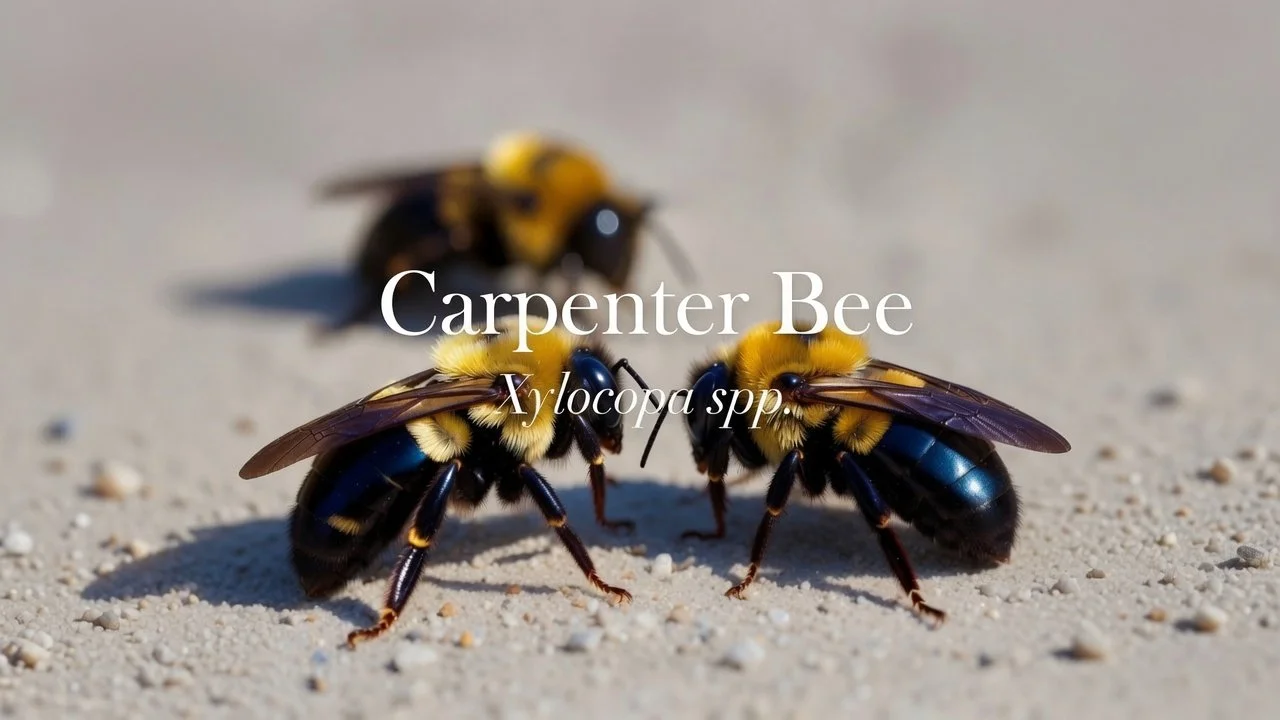
Carpenter bees are large, robust bees that look similar to bumblebees at a glance. The clearest difference is the abdomen: carpenter bees have a smooth, shiny, mostly hairless black abdomen, while bumblebees have a fuzzy abdomen with yellow or black hairs.
The thorax is covered in dense yellow, orange, or white hairs. Males often have a yellow or white spot on the face; females have an all-black face. Males cannot sting; females can but rarely do.
Biology & Life Cycle
Carpenter bees are solitary or loosely social. Adults overwinter in old nest tunnels and emerge in spring (typically April–May in Wisconsin). Females excavate new tunnels or reuse old ones, creating a series of cells stocked with pollen and nectar (“bee bread”). An egg is laid in each cell, then sealed with chewed wood pulp.
New adults emerge in late summer. The same wood can be used by successive generations for years.
Habits & Behavior
Females bore perfectly round entrance holes (about ½ inch diameter) into wood, then turn and tunnel along the grain. Preferred sites include unfinished or weathered softwoods such as pine, cedar, redwood, and spruce — especially eaves, fascia boards, deck railings, fence posts, and outdoor furniture.
Males are territorial and may hover aggressively near people or structures, but they are harmless. Females focus on nesting and foraging and are not aggressive unless handled.
Signs of Infestation
Perfectly round holes (about the diameter of a pencil) in wood surfaces
Coarse sawdust-like frass (wood shavings) below the holes
Bees hovering around the same area of wood, especially in spring
Staining or tunnels visible if wood is cut open
Health & Property Risks
Carpenter bees do not sting readily. The main concern is wood damage. Over several years, repeated nesting can weaken structural wood, fascia, decks, and outdoor furniture. They prefer soft, unfinished wood and generally avoid painted or sealed surfaces.
Prevention Tips
Paint, stain, or seal exposed wood surfaces
Use hardwoods or pressure-treated lumber where practical
Fill existing holes with wood putty or caulk after activity ends
Store firewood and scrap wood away from the structure
Hang untreated wood traps or sacrificial lumber away from the house if activity is heavy
Treatment Approach
Treatment focuses on the nest tunnels rather than flying bees:
Apply a labeled insecticidal dust or liquid into the entrance holes in the evening when bees are inside
Leave holes open for a few days so bees contact the treatment
Seal the holes with wood putty or caulk once activity has stopped
Treat unfinished wood surfaces preventively in spring if needed
Avoid broad spraying of flying bees — it is less effective and unnecessary.
When to Call a Professional
Call if:
Multiple holes appear in structural wood, fascia, or decking
Activity returns year after year in the same location
You need help locating and treating hard-to-reach tunnels
Wood damage is becoming significant
Local Notes
Eastern carpenter bees (Xylocopa virginica) are common across Racine County and southeastern Wisconsin. Activity peaks in spring when adults emerge and again in late summer. Unfinished or weathered softwoods on homes, decks, and outbuildings are the most frequent targets. Proper painting or sealing of wood is the most effective long-term prevention.