
Carpenter Ant (Camponotus spp.)
Quick Facts
Scientific name: Camponotus spp.
Worker size: ⅜ to ½ inch (queens up to 1 inch)
Color: Usually all black or black-and-red
Key feature: Evenly rounded thorax and single node on the waist
Main concern: Nesting in wood and becoming a household nuisance
Identification
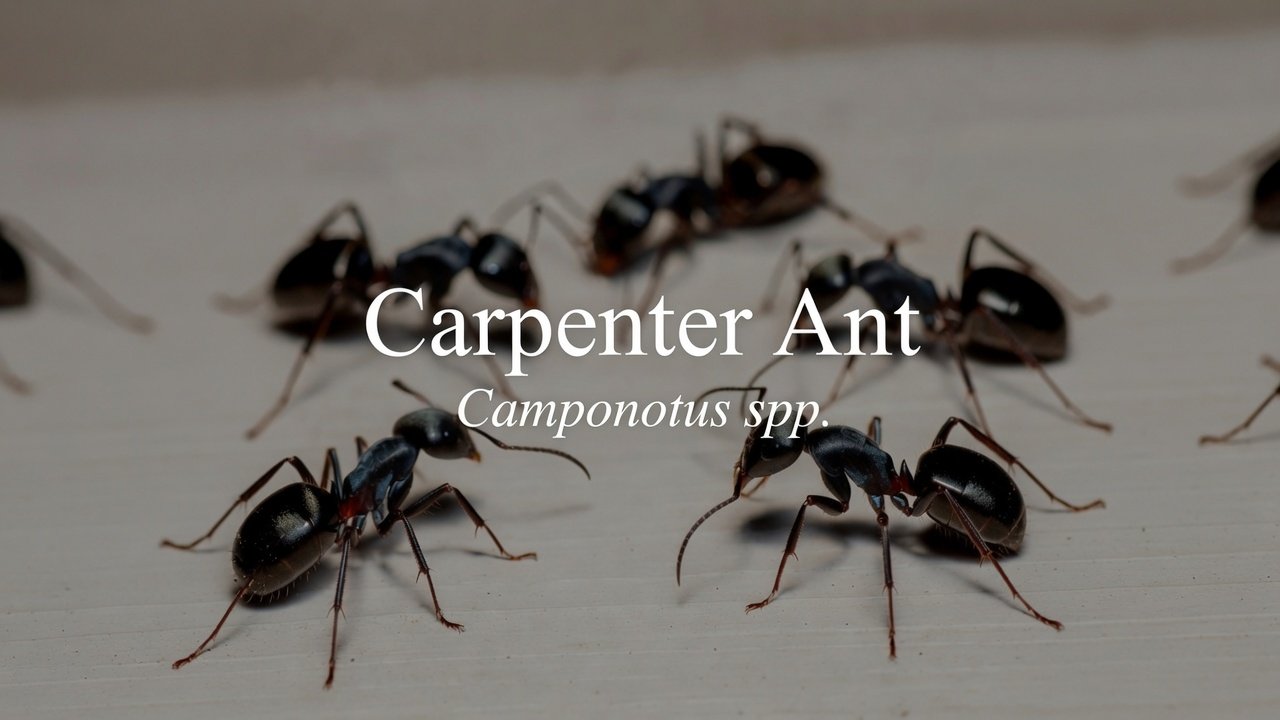
Carpenter ants are among the largest ants found in Wisconsin. Workers have a smooth, evenly rounded thorax when viewed from the side and only one node (segment) between the thorax and abdomen. Antennae are elbowed.
They are commonly all black, though some species have reddish markings. Size varies within the same colony (major and minor workers). Winged reproductive ants (swarmers) appear in late spring to early summer.
Biology & Life Cycle
A colony is started by a single queen after a mating flight, usually in late May or early June. The queen excavates a small cavity in wood or soil, lays her first eggs, and raises the first workers alone.
Colonies grow slowly at first but can become large over several years. They often establish a parent colony outdoors (in dead trees, stumps, or landscape timbers) and create satellite colonies indoors in wall voids, under floors, or in damp or damaged wood. Carpenter ants do not eat wood — they excavate it to create galleries for nesting.
Habits & Behavior
Outdoors they forage for insects, honeydew from aphids, and other protein or sugar sources. Indoors they are attracted to sweets, meats, and pet food.
Foraging trails often run along edges, baseboards, and utility lines. Activity is highest at night. Satellite colonies inside homes may be connected to an outdoor parent colony.
Signs of Infestation
Large black ants trailing indoors, especially at night
Piles of coarse sawdust-like frass (wood shavings mixed with insect parts) near baseboards, windows, or voids
Faint rustling or “crinkling” sounds in walls
Winged ants emerging indoors in spring
Small “windows” or exit holes in wood where frass is pushed out
Health & Property Risks
Carpenter ants do not sting and rarely bite. They do not transmit disease. The main risk is gradual structural damage if a colony is allowed to expand inside wood for years. They prefer already damp, soft, or previously damaged wood but can expand into sound wood over time.
Prevention Tips
Fix moisture problems (leaky roofs, plumbing, poor drainage, clogged gutters)
Replace or repair water-damaged wood
Keep firewood and landscape timbers away from the foundation
Trim tree branches that touch the house
Seal cracks and gaps around the foundation, windows, and utility penetrations
Eliminate outdoor nesting sites (dead trees, stumps, old wood piles) when practical
Treatment Approach
Effective control requires locating the nest(s). Treating only the foraging ants will not eliminate the colony.
Professional treatment typically includes:
Thorough inspection to find parent and satellite nests
Direct treatment of nests when accessible
Baits placed along foraging trails
Residual treatments in voids and around the exterior
Follow-up visits to confirm elimination
DIY sprays often scatter the colony and make the problem harder to solve.
When to Call a Professional
Call if:
You see large black ants regularly inside
You find frass or hear activity in walls
Winged ants appear indoors
Moisture or wood damage is present
Previous DIY efforts have not worked
Local Notes
Carpenter ants are one of the most common structural ant complaints in Racine County and southeastern Wisconsin. Older homes, homes with moisture issues, and properties with mature trees or wooded edges see the highest activity. Satellite colonies inside homes are frequent, even when the main nest remains outdoors.