
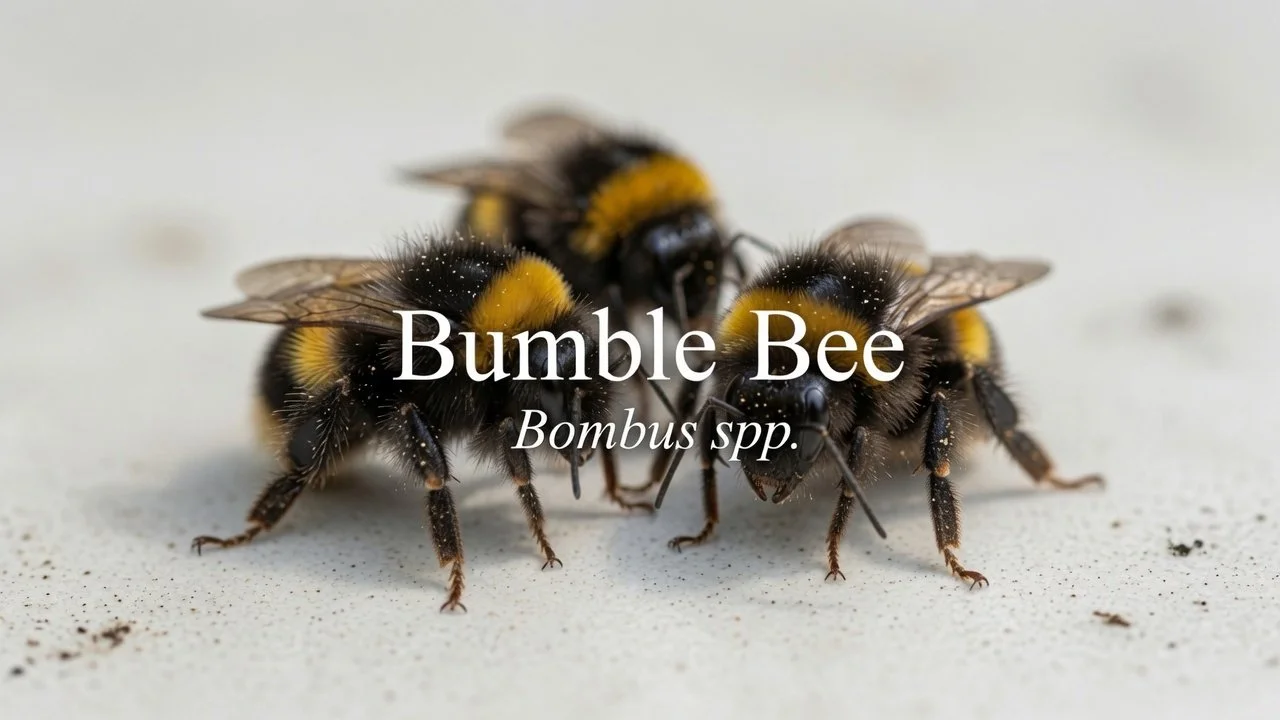
Bumble Bee (Bombus spp.)
Identification
Bumble bees are large, fuzzy bees with dense hair covering the entire body, including the abdomen. This is the easiest way to tell them apart from carpenter bees, which have a smooth, shiny black abdomen.
Color patterns vary by species. In Wisconsin, the Common Eastern Bumble Bee (Bombus impatiens) is the most frequently seen and has a yellow thorax with a black spot between the wings and mostly black abdomen with the first segment yellow.
Biology & Life Cycle
Bumble bees are social insects with annual colonies. A mated queen emerges in early spring, finds a nest site, and raises the first workers. The colony grows through summer. In late summer, new queens and males are produced, mate, and the old colony dies. Only the new queens overwinter (usually underground) to start the next year’s colonies.
Wisconsin is home to about 20 species of bumble bees.
Habits & Behavior
Bumble bees are generally non-aggressive when foraging. They will defend the nest if it is disturbed. They nest in abandoned rodent burrows, under piles of grass or leaves, in compost, birdhouses, or other protected cavities. They are excellent pollinators and are active in cooler weather than many other bees.
Signs of Activity
Large fuzzy bees with yellow and black patterning visiting flowers
Bees flying low to the ground and disappearing into a hole in the lawn, under a shed, or into a cavity
Increased activity around a fixed location in mid-to-late summer
Health & Property Risks
Bumble bees can sting and will defend their nest, but they are not aggressive when away from it. Stings can be painful and may cause allergic reactions in sensitive individuals. They do not damage wood or structures the way carpenter bees do. Nests in high-traffic areas (near doorways, play areas, or walkways) are the main concern.
Prevention Tips
Avoid disturbing potential nest sites in early spring
Keep grass relatively short near high-traffic areas if nests have been a problem in the past
Seal gaps under sheds, decks, and outbuildings where practical
Provide alternative nesting habitat away from the house if desired (e.g., undisturbed corners of the yard)
Treatment Approach
Bumble bees are beneficial pollinators, and many species are in decline. Live removal or leaving the nest alone is preferred whenever possible.
If a nest is in a high-traffic or high-risk location:
Treatment should be done carefully, preferably in the evening
Focus on the nest entrance rather than broad spraying
Professional treatment is recommended when the nest is large or difficult to access safely
Killing bumble bee colonies should be a last resort.
When to Call a Professional
Call if:
A nest is located near a doorway, play area, or other high-traffic location
Anyone in the household has a known bee-sting allergy
The nest is large or in a hard-to-reach spot
You need help distinguishing bumble bees from carpenter bees or other species
Local Notes
Bumble bees are common and valuable pollinators across Racine County and southeastern Wisconsin. The Common Eastern Bumble Bee is the species most often encountered. Several Wisconsin species have declined in recent decades, so conservation-minded approaches (leaving low-risk nests alone and protecting habitat) are strongly preferred.
Quick Facts
Scientific name: Bombus spp.
Adult size: About ½ to 1 inch (queens larger)
Appearance: Robust and fuzzy, with dense yellow and black hairs on both thorax and abdomen
Nesting: Usually underground or in protected cavities
Role: Important native pollinators