
The Monarchs Are Here. Then They're Gone. Here's Why.
Monarch Fast Facts
Scientific name: Danaus plexippus
Complete life cycle: Egg → caterpillar → chrysalis → adult
Egg stage: About 3–5 days
Caterpillar stage: About 9–14 days
Chrysalis stage: About 8–15 days
Summer adult lifespan: About 2–5 weeks
Migratory-generation lifespan: About 6–9 months
Maximum eastern migration distance: Up to about 3,000 miles
Typical migration speed: Up to about 70–75 miles per day under favorable conditions
Longest recorded single-day flight of a tagged eastern monarch: 265 miles
Caterpillar food: Milkweed only
Winter destination for Wisconsin's eastern monarchs: Central Mexico
The really strange part: The monarch that flies south in the fall generally does not make it all the way back to its original northern breeding grounds. Its offspring carry the journey north.
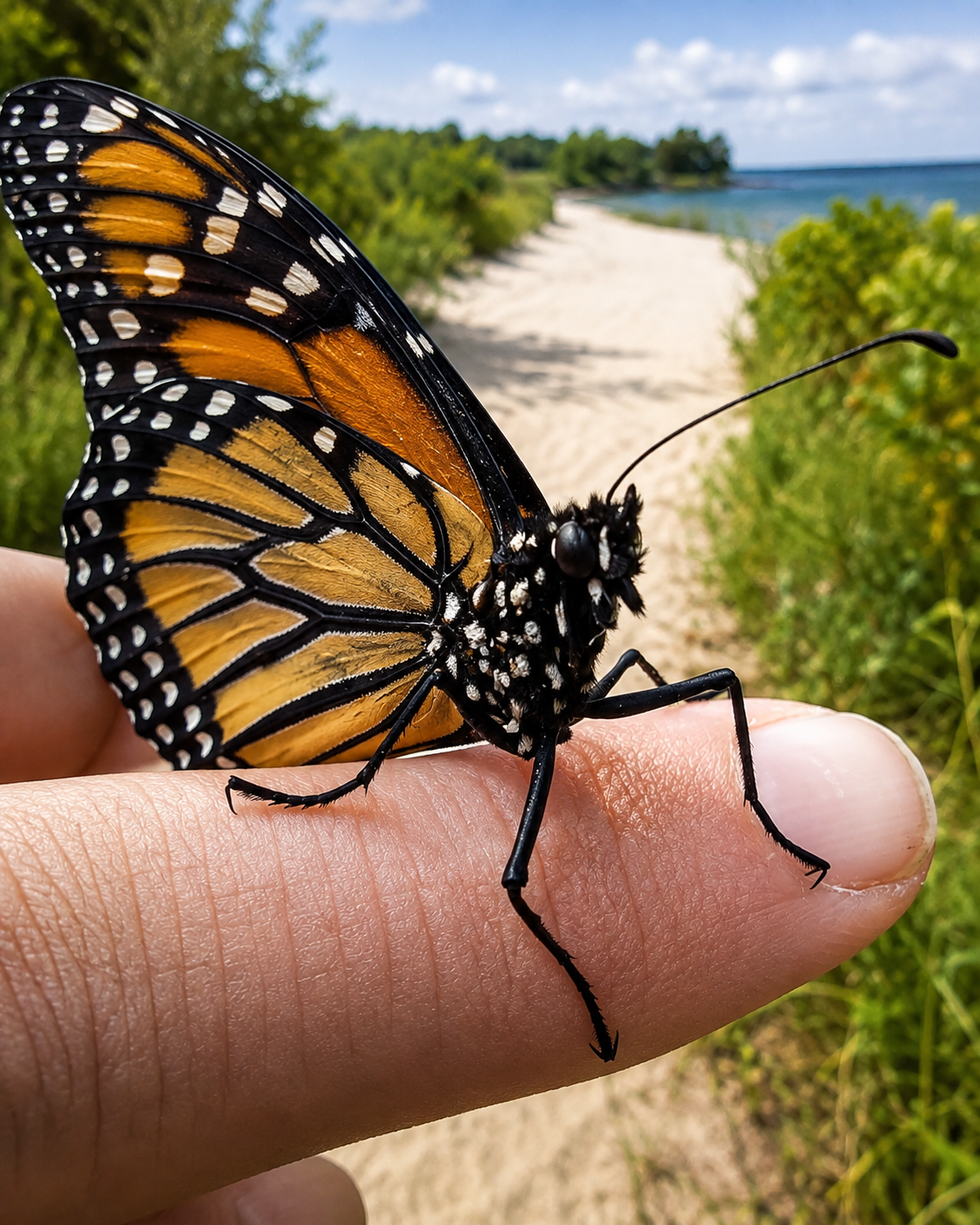
Every summer, monarch butterflies show up across Wisconsin. You may see them drifting through a backyard garden, feeding along a roadside, crossing a prairie, or stopping on a flowering plant beside a lake. Then, as summer winds down, something changes. The monarchs begin moving south. It is easy to think of this as one population making one big trip.
It is actually much stranger than that.
The monarchs that spend the summer breeding in Wisconsin are part of a multi-generational relay, and the butterflies that make the long trip to Mexico are biologically different from the generations that came before them. Some monarchs live only a few weeks. Others can live for most of a year.
So where do Wisconsin's monarchs come from? Where are they going? And why does one generation migrate while the generations before it simply live, reproduce and die?
Let's follow them through the year.
It Starts With Milkweed
A monarch's life begins with an egg, usually tucked onto a milkweed plant.
Female monarchs lay their eggs on milkweed because monarch caterpillars eat milkweed and only milkweed. The eggs are tiny—about the size of a pinhead—and normally hatch in about three to five days. A female can lay hundreds of eggs over her egg-laying period.
Once the egg hatches, the familiar striped caterpillar emerges.
And then it basically does one thing:
Eat.
The caterpillar, or larva, goes through five growth stages called instars. Each time it outgrows its skin, it molts and begins another stage. The entire larval period normally takes about nine to fourteen days under typical summer conditions. During that time, the caterpillar grows to nearly 2,000 times its original mass.
Eventually, the caterpillar reaches its fifth and final instar and leaves the milkweed plant to find a sheltered place to pupate.
It hangs upside down in its familiar J-shaped position, sheds its final caterpillar skin and becomes a green chrysalis.
About eight to fifteen days later, an adult monarch emerges.
From egg to butterfly, the transformation can happen in roughly a month.
But what happens after that depends heavily on when that butterfly was born.
Wisconsin Is a Breeding Ground, Not Just a Rest Stop
Wisconsin is an important part of the breeding range of the eastern North American monarch population.
Monarchs don't simply fly into Wisconsin, spend the summer here and then leave again as the same butterflies. Instead, several generations are produced here and farther north during the spring and summer.
Wisconsin DNR describes the state as being in the core breeding ground for the eastern migratory population.
That means the milkweed growing along Wisconsin roadsides, prairies, parks and gardens can become a nursery for several generations of monarchs.
And that brings us to one of the most interesting parts of the story:
Most monarchs born in Wisconsin will never fly to Mexico.
Summer-generation monarchs typically live only about two to five weeks as adults. Their primary job is reproduction: find nectar, find a mate, lay eggs and continue the population.
They don't need to make a 3,000-mile journey.
They just need to make the next generation.
A Butterfly's Calendar Matters
As summer progresses, monarch biology begins to change.
Earlier generations are focused on reproduction. But later in the season, decreasing day length, cooler temperatures, aging milkweed and changes in nectar availability help trigger a very different response.
The butterflies emerging in late summer and early fall can enter a state called reproductive diapause.
In simple terms, reproduction gets put on hold.
These monarchs don't immediately settle down to produce the next generation.
They're preparing to travel.
This is the generation often called the monarch super generation.
And it lives dramatically longer than the butterflies that came before it.
Summer monarchs generally live around two to five weeks. Migratory monarchs can survive for six to nine months.
That's an enormous difference for an insect.
The butterfly itself hasn't suddenly become a different species. Instead, the same species is producing adults with very different jobs depending on the season in which they emerge.
The Super Generation Has a Different Mission
The monarchs of the late-summer generation are preparing for a journey of thousands of miles.
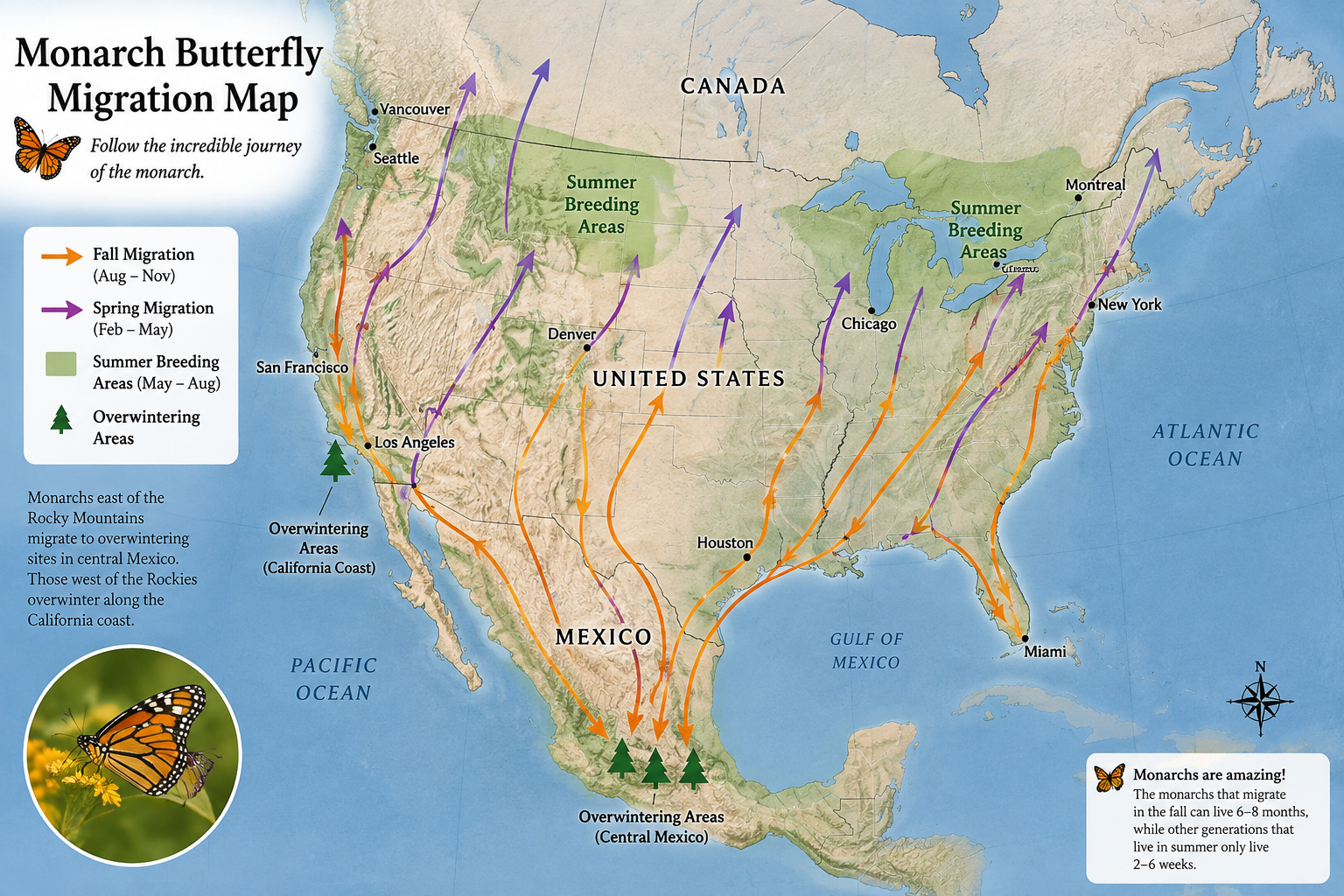
The eastern monarch population migrates from the northern United States and southern Canada all the way to overwintering sites in central Mexico. The trip can reach 3,000 miles and may take more than two months.
They aren't flying nonstop.
Along the way, monarchs need places where they can feed on nectar and find shelter from bad weather. Their route is influenced by weather, wind and the availability of suitable stopover habitat.
And they can cover some serious ground.
Tagging and observation data indicate that migrating monarchs can travel roughly 70 to 75 miles in a day under favorable conditions. The longest recorded single-day flight of a tagged eastern monarch was an astonishing 265 miles.
For a butterfly weighing about as much as a paper clip, that's a pretty remarkable road trip.
They Don't Just Head South
One of the easiest things to misunderstand about monarch migration is the idea that every butterfly simply points itself toward Mexico and flies until it gets there.
The actual migration is more complicated.
Monarchs funnel south through the eastern United States, using stopover areas where nectar plants and suitable shelter are available. Eventually they reach the mountains of central Mexico, where they gather in dense clusters in oyamel fir forests at high elevations.
The butterflies spend the winter conserving energy rather than reproducing.
And for the monarchs that left Wisconsin, this is where the journey becomes especially strange.
The Butterfly That Leaves Wisconsin Doesn't Come Back to Wisconsin
A monarch that leaves Wisconsin in the fall may eventually reach Mexico.
That same butterfly can survive the winter.
When spring arrives, it becomes reproductively active again, mates and begins moving north.
But it does not simply fly all the way back to Wisconsin.
Instead, the returning monarch begins laying eggs along the way, particularly as it moves through Texas and the southern United States. Those offspring continue northward.
So the butterfly that leaves Wisconsin isn't necessarily the one that returns.
In fact, it probably isn't.
The journey is carried by its descendants.
Monarch Joint Venture describes the eastern monarch cycle as generally involving three generations during the northward breeding season before the fourth generation becomes the migratory generation that heads back to Mexico.
That's why calling monarch migration a relay race isn't just a good metaphor.
It is basically what is happening.
One generation starts the journey.
Its offspring continue it.
Another generation continues farther north.
And eventually the migratory generation makes the long trip south.
A Monarch's Year in Wisconsin
The exact timing varies with weather and conditions, but the general pattern looks something like this:
Spring
Monarchs that survived the winter begin leaving Mexico and moving north.
They become reproductive again and lay eggs as they travel through the southern United States. Their offspring continue northward.
Late April and May
New generations move into the Midwest and Wisconsin.
Wisconsin's milkweed becomes important breeding habitat as monarchs begin producing another generation.
Wisconsin DNR notes that monarchs generally arrive in the state in late April and remain through the summer before heading south in early fall.
June and July
Breeding activity is in full swing.
Eggs become caterpillars. Caterpillars become chrysalises. Chrysalises become butterflies.
Then those butterflies reproduce.
The cycle repeats.
August
This is where things start to change.
The late-summer generation begins responding to environmental cues associated with the coming fall. Monarchs emerging after roughly mid-August in the eastern United States are increasingly likely to enter reproductive diapause and become part of the migratory generation.
Late August through September
Fall migration becomes increasingly obvious.
The butterflies are fueling up on nectar, building energy reserves and heading south.
October and November
The migrating population reaches Mexico and settles into its overwintering habitat.
By early November, monarchs are typically gathered in their wintering areas in the mountains of central Mexico.
Winter
They wait.
Then spring arrives.
And the entire process starts again.
So What Happens to the Butterflies That Don't Migrate?
This is one of the coolest parts of monarch biology.
The summer generations aren't failures because they don't migrate.
Their job is different.
A summer monarch lives fast. It develops, mates and produces another generation. Its short lifespan is part of the normal monarch life cycle.
The late-summer migratory generation has a completely different strategy.
It delays reproduction. It survives through winter. It travels thousands of miles. And in spring, it resumes reproduction.
Then it dies after passing the baton to its offspring.
So the monarch population isn't depending on every butterfly doing everything.
It divides the work between generations.
The Route Is More Than a Line on a Map
Scientists have learned a remarkable amount about monarch migration through tagging, observation and other tracking methods.
Tiny identification tags placed on monarch wings have helped researchers connect butterflies seen in the northern breeding grounds with butterflies later recovered in Mexico. These observations have helped reveal how far individual monarchs travel and how the generations divide the migration.
Researchers also know monarchs use environmental cues to orient themselves during migration, including the position of the sun and seasonal changes.
And there is an important misconception worth clearing up:
Wisconsin Is Part of the Bigger Picture
The importance of Wisconsin to monarchs isn't just that butterflies happen to pass through here.
They reproduce here.
Wisconsin provides milkweed for caterpillars and flowering plants for adults. The Wisconsin DNR identifies the state as an important part of the eastern monarch breeding range, and the state has been a major focus of habitat restoration efforts.
Milkweed is especially important because monarch caterpillars cannot substitute another plant for it. Adults, however, need nectar from a much broader selection of flowering plants.
That makes habitat particularly important during the entire season—not just when the butterflies are migrating.
A patch of milkweed can help produce the next generation.
Late-season flowers can help fuel the generation that leaves.
Sources
Wisconsin Department of Natural Resources, Monarch Habitat Takes Off in Wisconsin and Make a Place for Monarchs.
U.S. Fish & Wildlife Service, Monarch (Danaus plexippus) and The Phenomenal Monarch Migration.
Monarch Joint Venture, Life Cycle, Migration and Monarch Biology FAQs.
Monarch Watch, Monarch Biology.