
Bumble bees? Or Carpenter Bees? Just look at their butts!
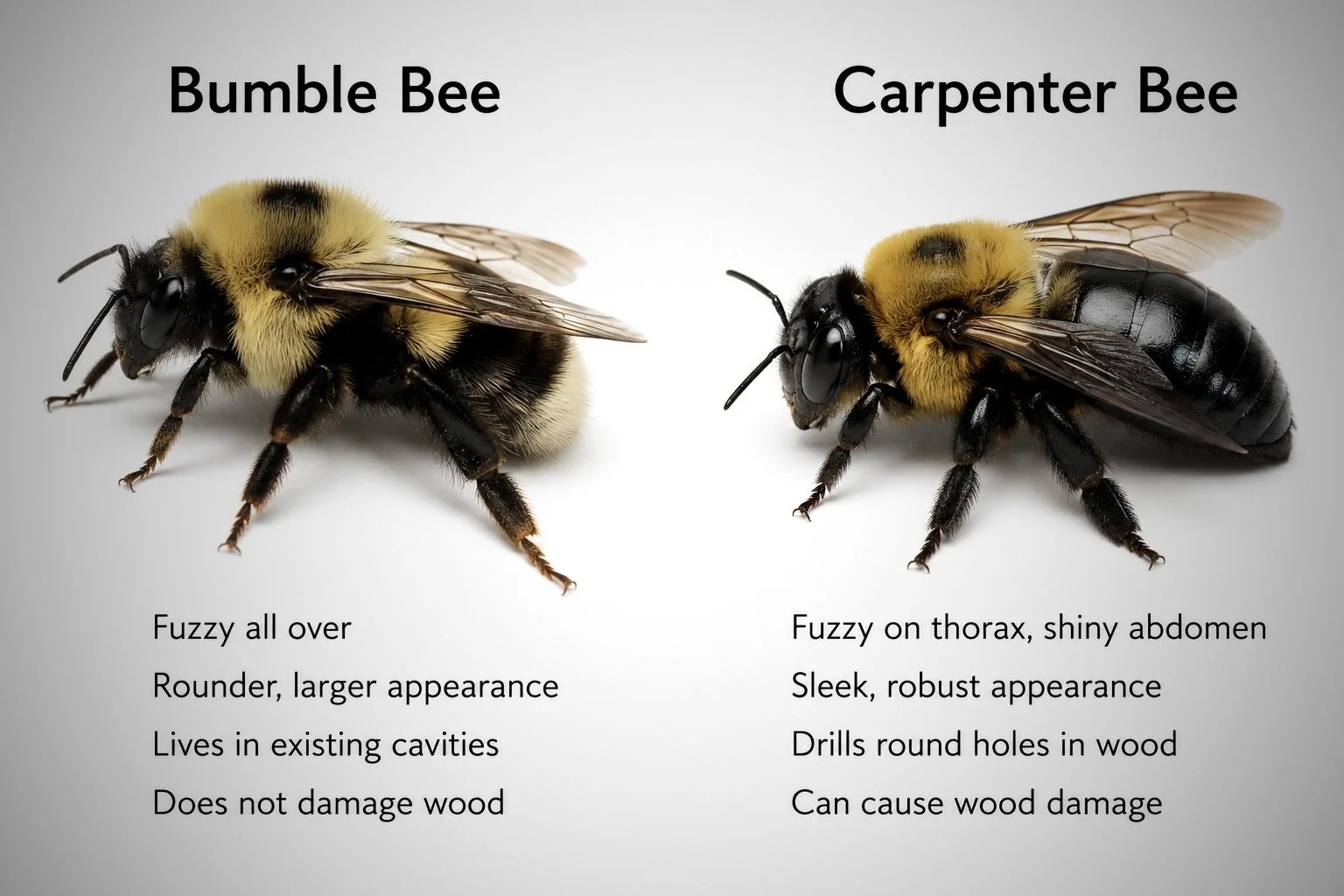
Bumble/ Carpenter Bee Fast Facts
Bumble bees: Bombus spp.
Carpenter bees: Xylocopa spp.
Bumble bee: Fuzzy abdomen
Carpenter bee: Shiny, mostly hairless abdomen
Carpenter bee nest: Tunnels excavated into wood
Male carpenter bees: Cannot sting
Both: Important pollinators
They’re big. They’re loud. They’re often flying around flowers, decks, sheds, and homes. And if you see one buzzing around your property, you might assume you’re looking at a bumble bee.
But there’s another bee that can look remarkably similar: the carpenter bee.
While both are important pollinators, they have very different nesting habits—and that difference matters when you’re trying to figure out whether the bee in your yard is simply visiting your flowers or potentially making a home in your wood.
The Quickest Way to Tell Them Apart
The easiest clue is to look at the abdomen.
BUMBLE BEES
Bumble bees are typically:
Large and robust
Covered in dense, fuzzy hair
Often black and yellow, although their colors vary by species
Fuzzy across both the thorax and abdomen
Wisconsin is home to approximately 20 species of bumble bees, and many are active throughout the growing season. (Wisconsin Horticulture)
CARPENTER BEES
Large carpenter bees are also large and robust, but there’s a major difference:
Their abdomen is largely bare and shiny.
The thorax is covered with yellowish or other colored hairs, while the upper surface of the abdomen has a noticeably glossy, almost polished appearance. (Ohioline)
So if you’re looking at a big bee and thinking, “That thing looks like a bumble bee, except its butt is shiny,” there’s a good chance you’ve found a carpenter bee.
Bumble Bees Live in Nests. Carpenter Bees Make Tunnels.
This is probably the biggest practical difference for homeowners.
Bumble bees generally establish their nests in preexisting cavities. In Wisconsin, those can include abandoned rodent burrows and other protected spaces, including cavities above ground. Their colonies are relatively small, typically consisting of dozens to a few hundred workers. (Wisconsin Horticulture)
Carpenter bees take a different approach.
They excavate their own nests in wood.
Female large carpenter bees use their powerful jaws to chew tunnels into wood, creating galleries where they raise their young. They don’t eat the wood; they excavate it to create their nesting space. (Ohioline)
That can include dead trees and branches—but unfortunately, it can also include structures around your home.
Decks, fascia boards, eaves, sheds, fences, and other exposed wooden structures can all potentially become nesting sites.
What Does a Carpenter Bee Hole Look Like?
One of the easiest ways to recognize carpenter bee activity is the entrance hole. A typical entrance is remarkably round, often looking as though someone drilled a clean hole into the wood.
The bee enters the hole and then excavates a tunnel running deeper into the wood. You may also notice coarse sawdust or wood debris beneath the entrance.
If you see a perfectly round hole in a wooden structure and large bees repeatedly entering and exiting it, carpenter bees should be high on your list of possibilities.
Carpenter Bees Don’t Eat Your House
Carpenter bees are sometimes compared to termites because they damage wood, but their behavior is completely different.
Carpenter bees don’t eat wood. They’re excavating it to create nesting galleries.
That doesn’t mean the damage should be ignored. Repeated nesting activity over multiple seasons can create additional tunnels and weaken or damage susceptible wooden components, particularly when the same areas are repeatedly used.
But carpenter bees are still bees—and they’re also pollinators.
Are Carpenter Bees Aggressive?
This is where things get interesting.
You may have seen a large carpenter bee hovering aggressively around a deck or building and thought, “That thing is going to attack me.”
Usually, that’s not what’s happening.
Male carpenter bees are famously territorial and will often investigate or chase people and other insects that enter their territory.
The important part?
Male carpenter bees cannot sting.
Females have a stinger, but they’re generally not aggressive and typically sting only when handled or seriously disturbed.
So that big bee buzzing around your head may be putting on an impressive show without actually being capable of stinging you.
What About Bumble Bees?
Bumble bees are generally considered docile as well, but there’s one important difference.
They can sting.
A bumble bee is unlikely to bother you simply because you’re walking through the yard, but disturbing a nest is another matter. Wisconsin Extension notes that bumble bees are typically docile and unlikely to sting unless their nest is disturbed. (Wisconsin Horticulture)
If you discover a bumble bee nest in an area that isn’t causing a problem, leaving it alone is often the best option.
Both Bees Are Important Pollinators
It’s easy to look at carpenter bees differently once they’re drilling into your deck.
But it’s worth remembering that carpenter bees are still valuable pollinators.
Bumble bees are particularly effective pollinators because their large, hairy bodies are excellent at collecting pollen, and their ability to perform buzz pollination makes them especially useful for certain plants. (Wisconsin Horticulture)
Carpenter bees also visit a wide variety of flowers and contribute to pollination. In some cases, they can even “rob” nectar from flowers by cutting into the side of a flower rather than entering through the normal opening. (Michigan State University Extension)
They’re not simply destructive insects.
They’re bees doing what bees do.
When Should You Be Concerned?
Seeing a carpenter bee flying around your flowers isn’t necessarily a problem.
Finding carpenter bees repeatedly entering holes in an important wooden structure is a different story.
Likewise, discovering a bumble bee nest doesn’t automatically mean the colony needs to be eliminated.
The right response depends on what species you’re dealing with, where they’re nesting, and whether they’re actually creating a problem.
That’s why identification should come before treatment.
Sometimes the best solution is simply leaving a beneficial pollinator alone. Other times, when bees are nesting directly in a structure or creating a legitimate concern, professional intervention may be appropriate.
If you have a large bee around your home and aren’t sure whether you’re looking at a bumble bee or carpenter bee, take a picture and give us a call.
Knowing what you’re looking at is the first step toward knowing what to do next.