
Yellow Jacket (Vespula spp.)
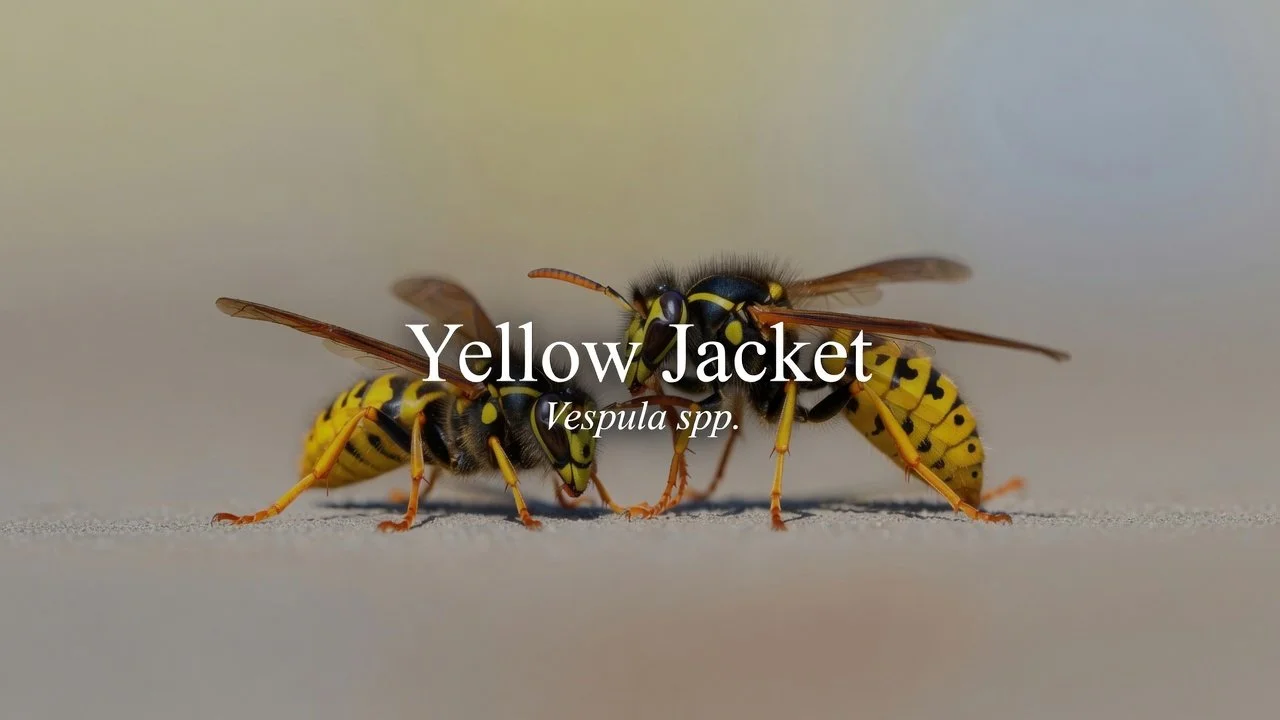
Quick Facts
Quick Facts
Common species in Wisconsin: Eastern yellowjacket (Vespula maculifrons) and German yellowjacket (Vespula germanica)
Adult size: About ⅜ to ⅝ inch
Color: Bright yellow and black with a smooth, shiny body and very little hair
Peak activity: Late summer through early fall in southeastern Wisconsin
Identification
Yellow jackets are social wasps with a slender waist, bright yellow-and-black markings, and a relatively hairless body. Their wings fold lengthwise at rest. They are often confused with honey bees, but bees are fuzzier and have pollen baskets on their hind legs.
Unlike paper wasps, yellow jackets have a more compact body and typically nest in the ground or in wall voids rather than open, umbrella-shaped nests.
Biology & Life Cycle
Colonies are annual. A fertilized queen starts a new nest in spring. The colony grows through the summer, peaking at hundreds to several thousand workers by late summer or early fall. New queens and males are produced in late summer. The colony dies with the first hard freezes; only new queens overwinter.
Workers forage for both protein (insects, meat) and sugars (nectar, fruit, soft drinks).
Habits & Behavior
Most yellow jackets nest underground in old rodent burrows or similar cavities. Some species (especially the German yellowjacket) frequently nest in wall voids, attics, or other structural cavities.
They become more aggressive and scavenging-oriented in late summer and fall as the colony grows and natural food sources change. This is when they are most noticeable around outdoor eating areas, trash cans, and picnics in Racine County.
Signs of Infestation
Workers flying in and out of a single hole in the ground, lawn, or landscape
Increased activity around outdoor food, drinks, or garbage
Visible papery nest material if the nest is in a wall void or structure (sometimes revealed when they chew through drywall or exit light fixtures)
Aggressive defense if the nest is disturbed
Health & Property Risks
Yellow jackets can sting repeatedly. Stings are painful and can cause severe allergic reactions in sensitive individuals. Large colonies near high-traffic areas (yards, playgrounds, decks) create a real safety concern. Structural nests can also lead to secondary issues if workers begin entering living spaces.
Prevention Tips
Keep outdoor trash cans tightly covered
Clean up fallen fruit and outdoor food scraps promptly
Seal potential entry points into wall voids and attics
Avoid leaving sugary drinks or open food unattended outdoors in late summer
Be cautious when mowing or working near ground holes that show insect traffic
Treatment Approach
Do not attempt to treat a large or aggressive nest yourself. Professional treatment typically involves:
Locating the nest entrance (ground or structural)
Applying targeted insecticides after dark when most workers are inside
Follow-up to confirm the colony is eliminated
Exclusion of structural entry points when the nest is in a building
Ground nests are often treated with dusts or residual products applied into the entrance. Structural nests may require void treatments and careful sealing afterward.
When to Call a Professional
Call if:
The nest is in a high-traffic area
Anyone in the household has a known sting allergy
The nest is inside a wall, attic, or other structure
You see heavy traffic or aggressive behavior
You are not comfortable treating it safely
Late summer is the peak season for yellow jacket problems across Racine and southeastern Wisconsin.
Local Notes
Yellow jackets are one of the most common stinging insect complaints in southeastern Wisconsin from August through early October. Ground nests in lawns and landscaping are frequent, as are wall-void nests in older homes and outbuildings. Colonies die out with hard freezes, but new queens start the cycle again each spring.