
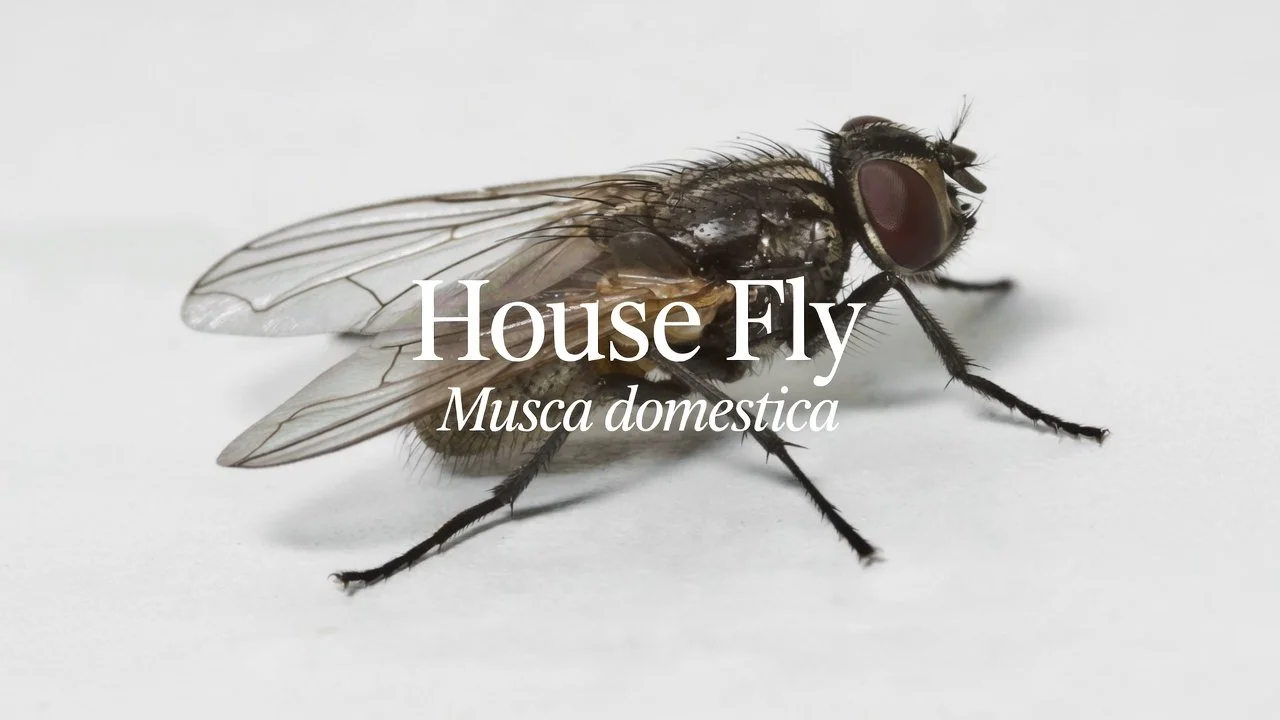
House Fly (Musca domestica)
Quick Facts
Scientific name: Musca domestica
Adult size: About ⅛ to ¼ inch
Appearance: Dull gray body with four dark stripes on the thorax and reddish eyes
Breeding sites: Moist decaying organic matter, garbage, manure
Health concern: Can mechanically transmit pathogens
Identification
House flies are medium-sized flies with a dull gray body, four distinct dark longitudinal stripes on the thorax, and large reddish compound eyes. They have sponging (non-biting) mouthparts. The wings are transparent with visible veins.
They are easily distinguished from larger blow flies (which are often metallic) and smaller fruit flies.
Biology & Life Cycle
Females lay batches of eggs in moist, decaying organic material such as garbage, animal manure, compost, or rotting vegetation. Eggs hatch in less than a day under warm conditions. Larvae (maggots) feed and develop for several days before pupating. The full cycle from egg to adult can be completed in as little as 7–10 days in warm weather. Adults typically live 2–4 weeks.
Habits & Behavior
House flies are strongly associated with human activity and rarely found far from dwellings or livestock. They feed on a wide range of materials, including food, garbage, and animal waste. When feeding they regurgitate digestive fluids and leave fecal spots, which can contaminate surfaces. They are strong fliers but usually stay within a mile or two of their breeding site.
Signs of Infestation
Adult flies resting on walls, ceilings, or counters indoors
Clusters of flies outdoors near garbage, dumpsters, or animal areas
Maggots in garbage cans, compost, or other moist organic material
Speckling (fly spots) on windows, light fixtures, and walls
Health & Property Risks
House flies do not bite, but they can mechanically carry bacteria and other pathogens from filth to food and surfaces. This makes them a hygiene concern, especially in kitchens and food-handling areas. Heavy populations are a significant nuisance.
Prevention Tips
Keep garbage in sealed containers and empty regularly
Clean garbage cans and dumpsters to remove residue
Eliminate or manage animal manure and wet organic debris
Install and maintain tight-fitting screens on windows and doors
Keep doors closed when possible
Clean up food spills and pet waste promptly
Treatment Approach
Sanitation is the foundation of control.
Remove breeding sources first
Use sticky traps, UV light traps, or residual sprays on resting surfaces for adult flies
Apply labeled larvicides to breeding sites that cannot be cleaned immediately
Space sprays or foggers can provide temporary adult knockdown but do not solve the source
Professional treatment is useful when populations are high or breeding sites are difficult to eliminate.
When to Call a Professional
Call if:
Fly numbers remain high despite sanitation efforts
Maggots are found in hard-to-reach or ongoing breeding sites
The problem is linked to neighboring properties or commercial waste
You need help identifying the primary breeding source
Local Notes
House flies are common throughout Racine County and southeastern Wisconsin from late spring through fall. They are most noticeable around homes with outdoor pets, compost, or nearby livestock or dumpsters. Consistent garbage management and exclusion (screens and closed doors) are the most effective long-term measures.